
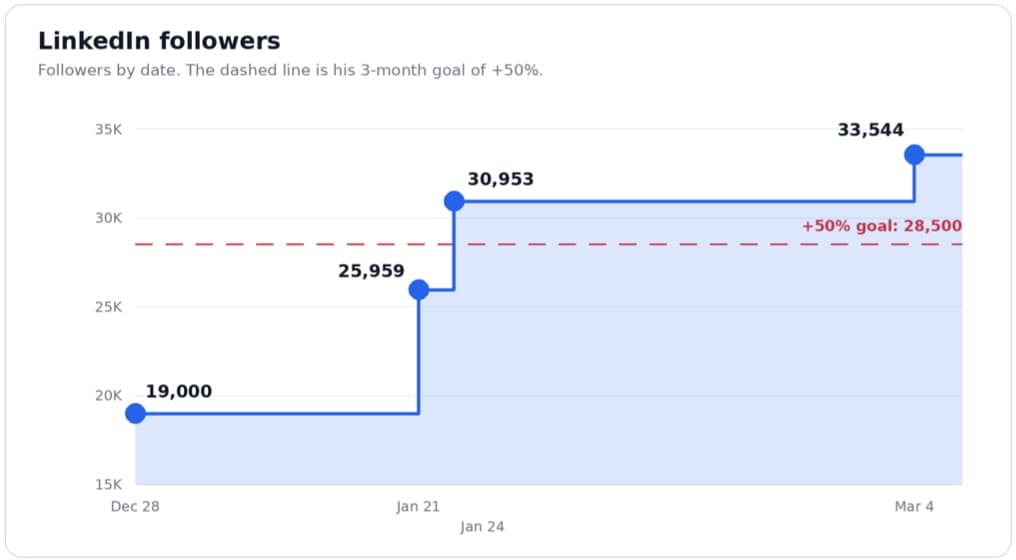
Before us, his best posts came from big life moments years apart
He'd been posting for about 9 months, on and off. His top posts announced the sale of his first company in 2021 and told the story of his Ironman 3 years later.
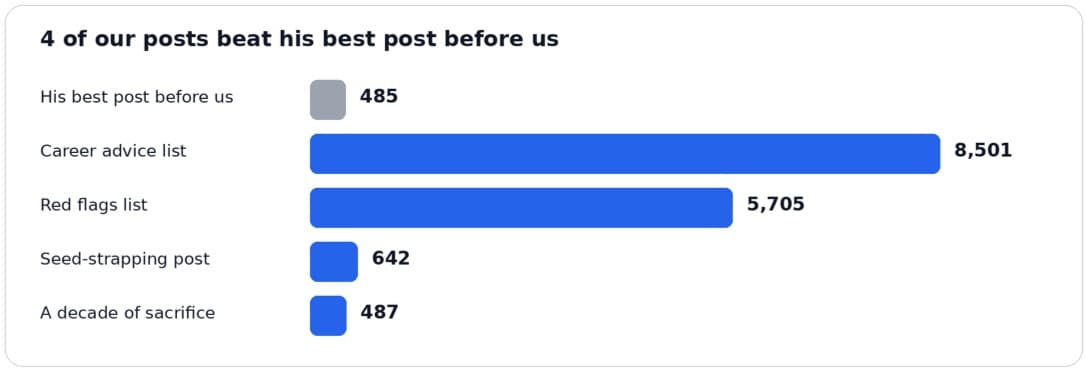
The system: 6 steps, from research to the week after a hit
Research goes in, and the reactions tell us what to write next: a Part 2, a remix, or a tighter list.
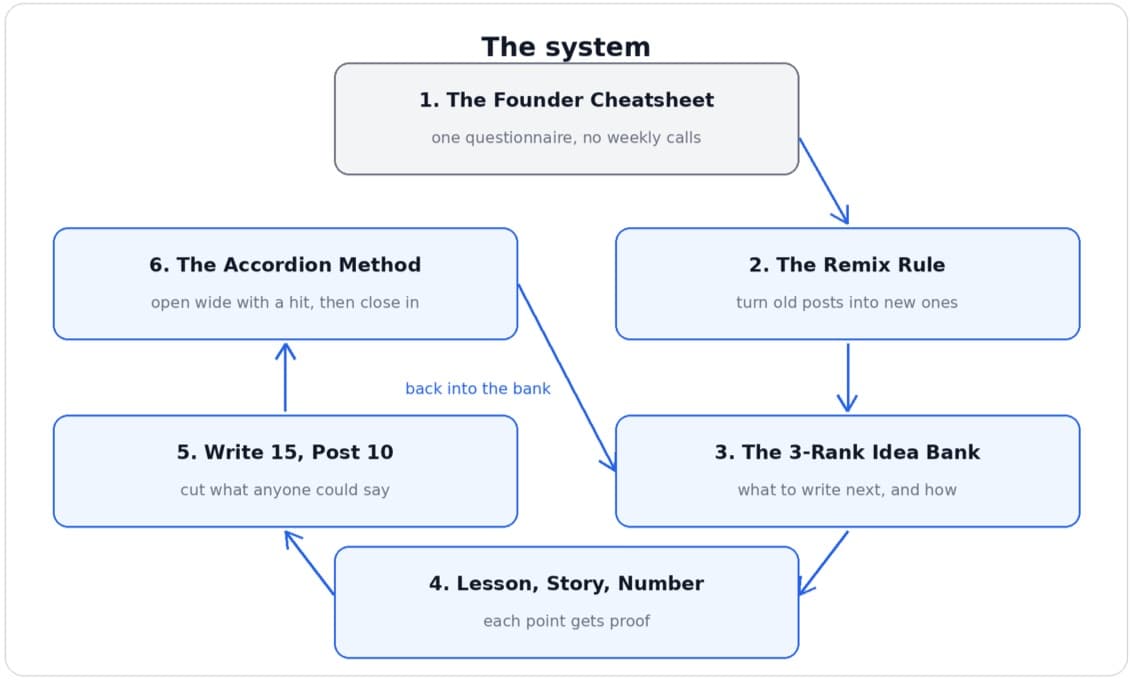
1. The Founder Cheatsheet: one questionnaire instead of weekly interviews
A busy founder doesn't have time for weekly interviews, and most of what you need is already on the record. So send one questionnaire, then do the research yourself:
- Podcast interviews, saved as transcripts so you can search them
- Old blog posts, articles and their personal site
- The posts the founder considers their best
Put the answers and the research on one page. The goals answer also tells you who to write for.
How we applied it: his goal was growing his businesses, so we wrote for 3 audiences: the ecommerce brands his software company sells to, founders raising money, and anyone building a career.
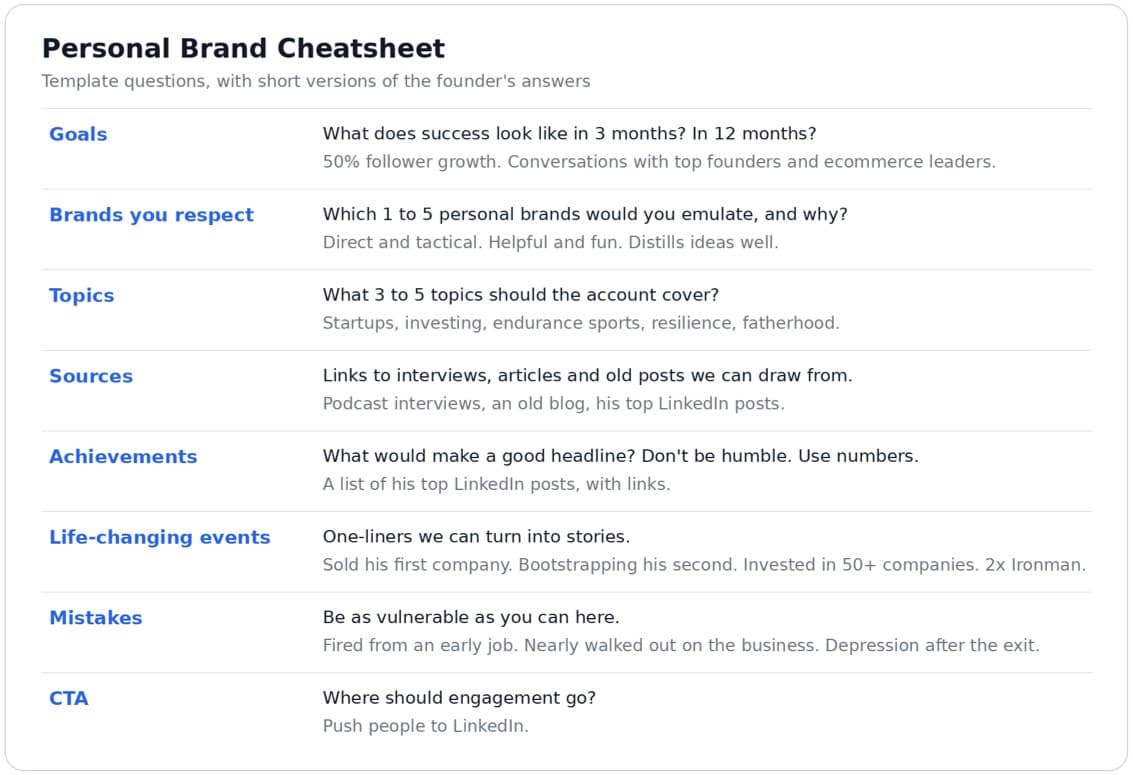
Here are the questions, so you can copy them:
- Goals: What does success look like in 3 months? In 12 months?
- Brands you respect: Which 1 to 5 personal brands would you emulate, and what do you like about each one?
- Topics: What 3 to 5 topics should the account cover, and which matter most?
- Sources: Links to the interviews, articles and old posts we can draw from.
- Achievements: What would make a good headline? Don't be humble, and use numbers.
- Life-changing events: One-liners we can turn into stories.
- Mistakes: "Be as vulnerable as you can here."
- CTA: Where should engagement go?
2. The Remix Rule: turn old posts into new ones
Old posts hold ideas already in the founder's words. Remix the short ones that didn't get their full story.
- Find a short post with a strong idea, like a list of one-liners.
- Keep the hook and the idea.
- Add what it was missing: the stories and the numbers.
How we applied it: his biggest post started as a list of 7 lessons he'd posted 2 months before we started, one line each. We kept his opener and gave each line a story.
3. The 3-Rank Idea Bank: know what to write next and how to write it
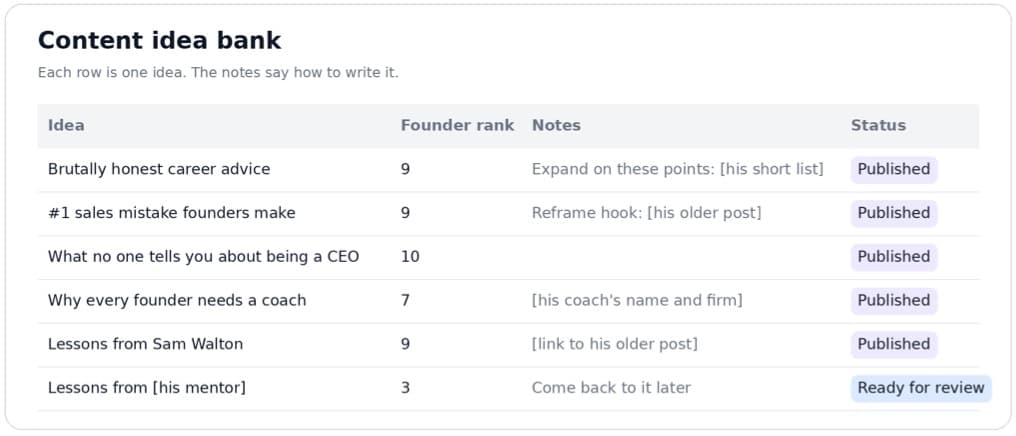
Keep the ideas in one database. Give each 3 ranks and a note, then write the top one first:
- Founder rank: what the founder is excited to say, so approvals come quickly.
- Writer rank: whether there's a hook and a proof story.
- Audience rank: whether the topic or format has done well before.
- The note: a few words on what to change, plus a link to the post it builds on, like "Expand on these points" or "Reframe hook."
4. Lesson, Story, Number: give each one-liner proof only the founder has
Anyone can write a bulleted lesson, so they come out generic. Give each point 3 parts:
- Lesson: the one-liner, in the founder's words.
- Story: a moment from their life when it proved true.
- Number: one figure that shows it happened.
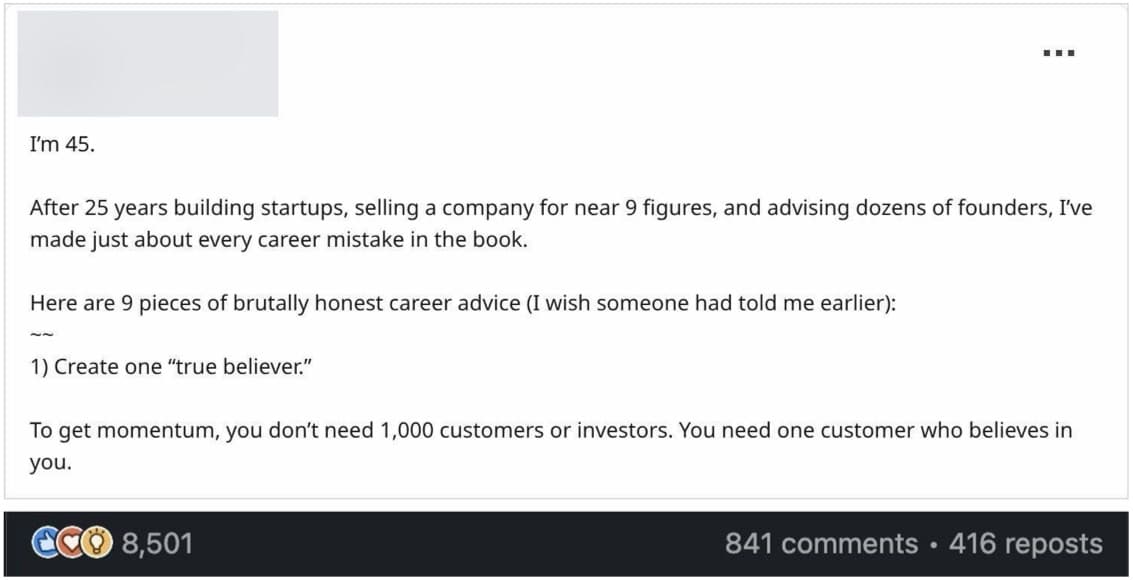
How we applied it: "Never waste a good crisis" became: "In 2018, our growth stalled from 100% to 15% YoY growth... 2 years later we sold the company after our highest profit year ever." When a lesson had no story yet, the research filled it: "With $750k in funding, we scaled [his first company] to $100M+ in revenue."
| His one-liner | The point in the post |
|---|---|
| "You just need to create one 'true believer' to get started." | "Create one 'true believer.' To get momentum, you don't need 1,000 customers or investors. You need one customer who believes in you. Find them, deliver beyond expectations, and they'll become your biggest advocate." |
| "God made you whole. There is no hole to fill." | "God made you whole. There's no hole to fill. When I sold my company, I thought the money would fix everything (my insecurities, my fears, my self-worth). Spoiler: it didn't." |
5. Write 15, Post 10: cut the points anyone else could have written
A list is only as strong as its weakest point. So draft 15 points for a post of 10, then cut 5.
The test: cover the founder's name. If another expert could have written the point, cut it.
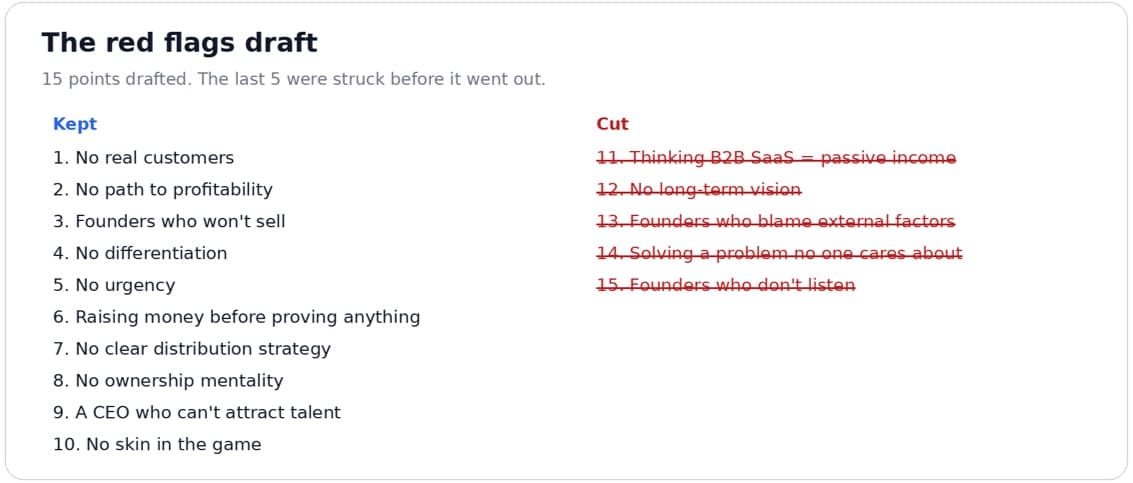
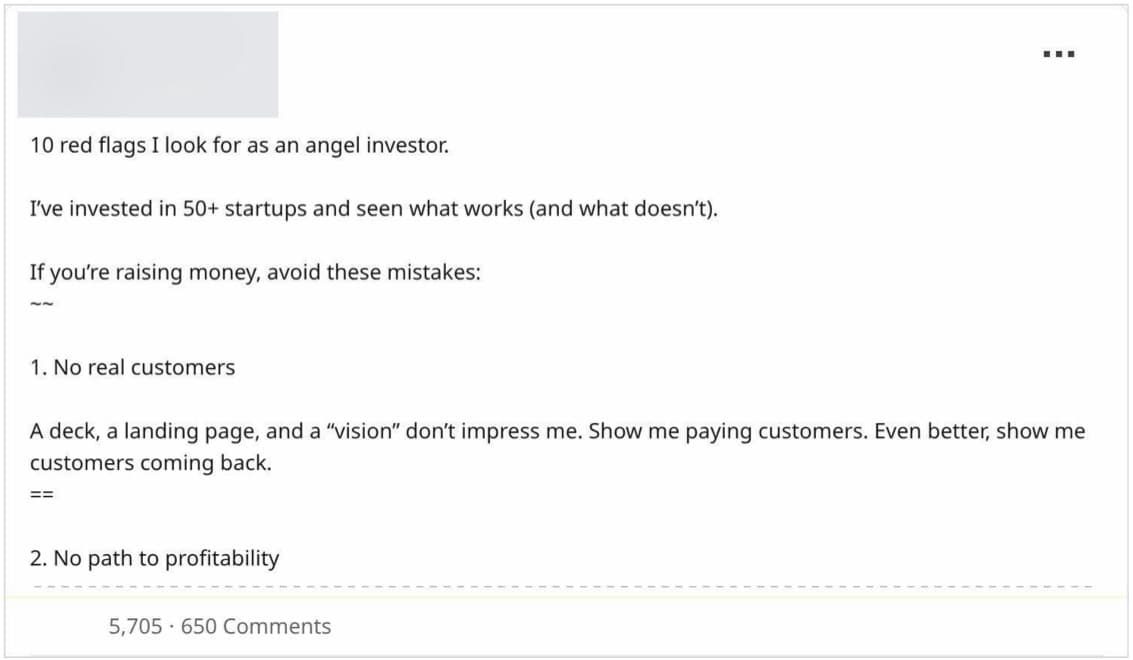
How we applied it: "Founders who don't listen" could have come from any investor, so it went. "First-time founders obsess over features. Second-time founders obsess over distribution." could only come from someone who has started 2 companies, so it stayed.
6. Use the Accordion Method: reach new people with a hit, then keep them with the founder's story
A post that hits opens the accordion wide, and a lot of new people see the founder for the first time. Then you close it in. For the next 4 days, post the founder's story so the new people stay.
How we applied it: his career advice post hit on a Monday. Here's his week:
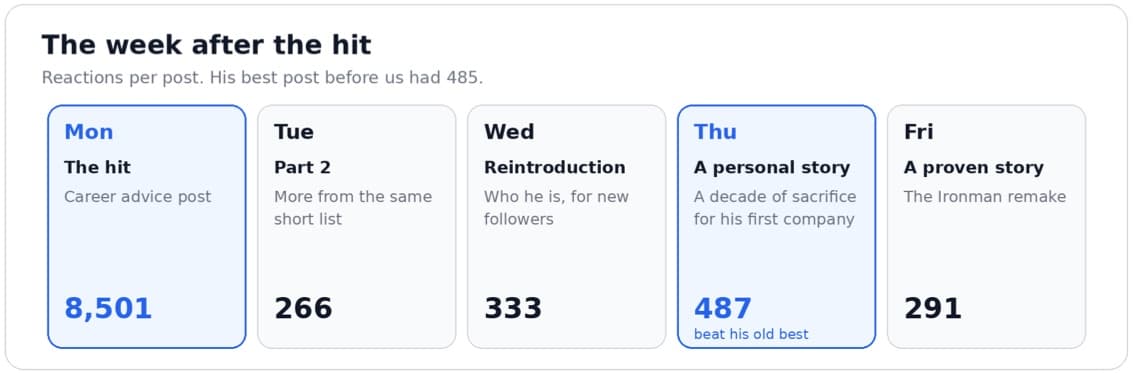
- Day 2, Part 2: more from the same list. Ours was 10 more pieces of career advice.
- Day 3, the reintroduction: who the founder is, using the template below.
- Day 4, a personal story: the person behind the advice. Ours was the decade he spent sacrificing his health and family for his first company.
- Day 5, a remix: a post that worked before, rewritten. We kept the best lines of his Ironman post, cut the setup to 3 short lines, and turned his excuses into a list.
Here's the reintroduction template, with each part labeled:
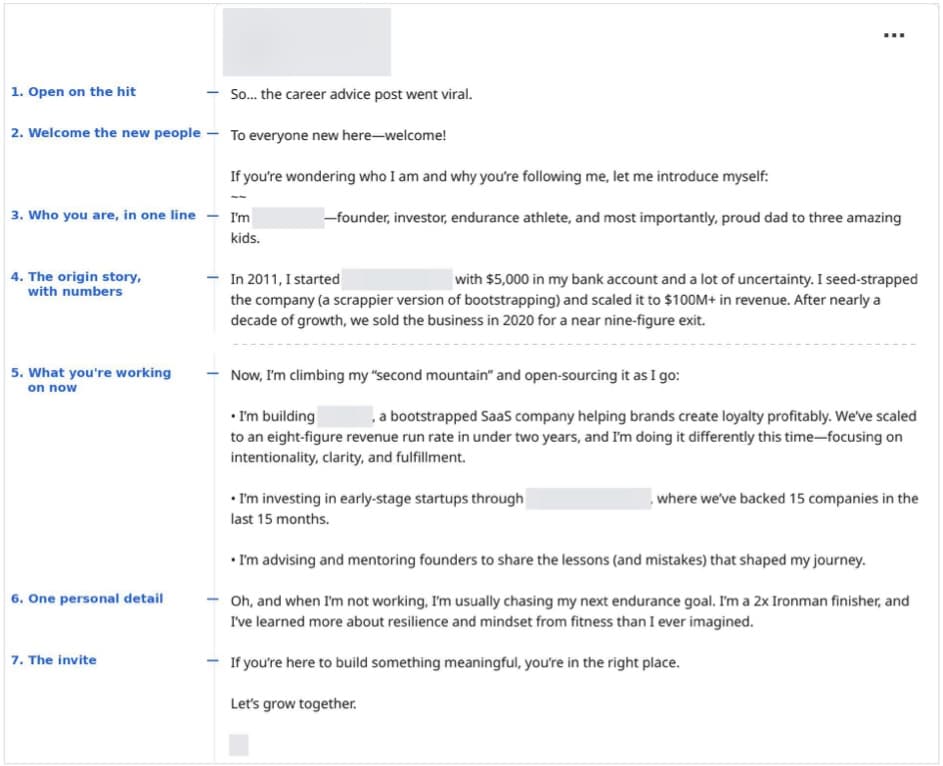
- Open on the hit in plain words.
- Welcome the new people.
- Say who you are in one line.
- Tell the origin story with 1 or 2 numbers.
- List what you're working on now.
- Add one personal detail.
- Close with an invite.
