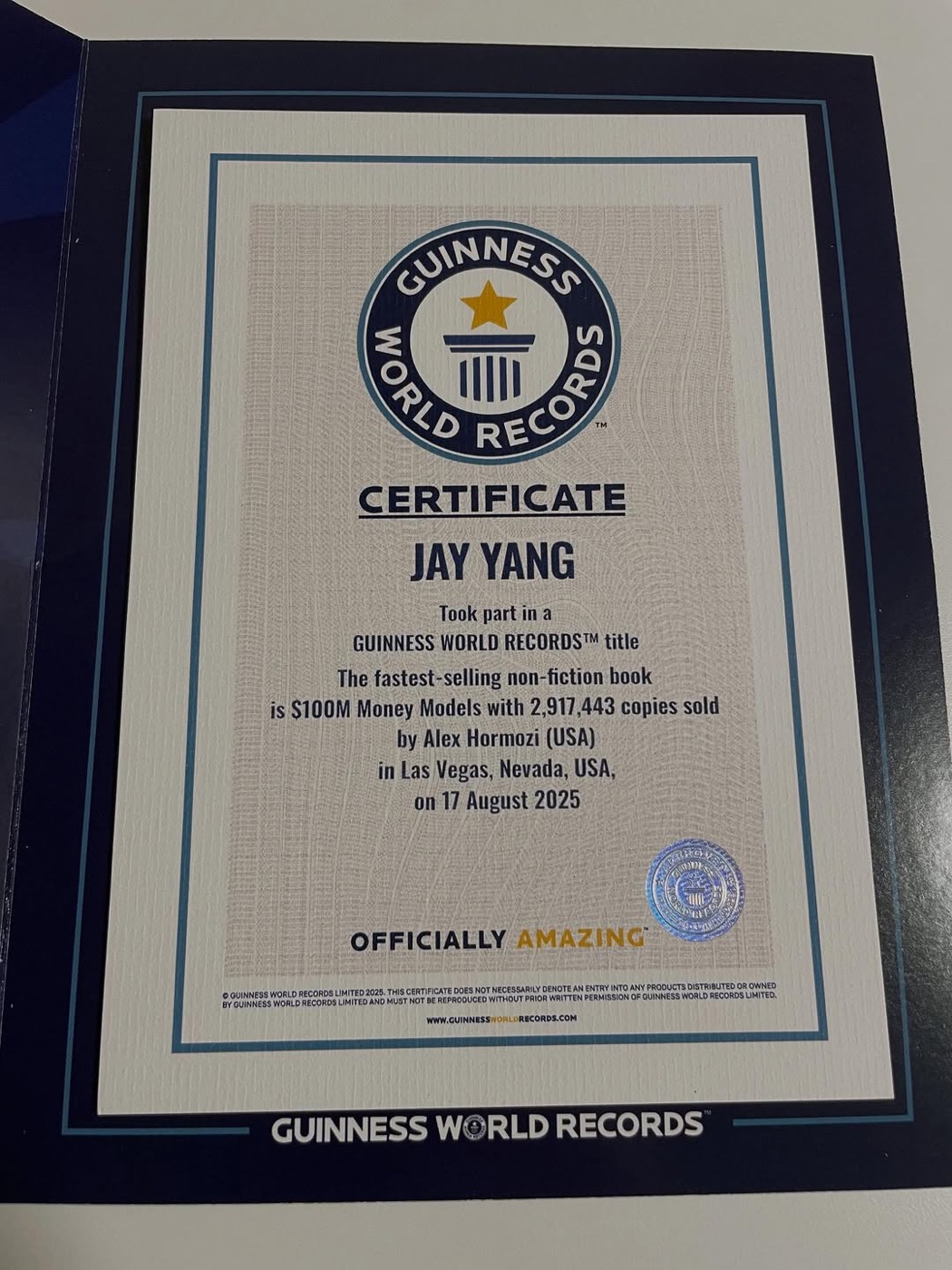
We wrote ad copy for the launch of Alex Hormozi’s $100M Money Models.
It sold 2,917,443 copies and took the Guinness World Record for fastest-selling non-fiction book. The launch did $105M.
We filmed over 1,500 pieces of creative and ran over 2,600 ads.
Here’s how:
Use the 6Ps
Copywriting was never about the writing. It’s about the thinking behind the words.
Identity callouts, outcome hooks, promise hooks — they all work. But if you don’t know why they work, all you can do is repeat them. Instead, I want to teach you how to fish.
Before we write copy, we first write down our answers to the 6Ps.
People. Who is this for? You can’t answer “why should they choose us” until you answer “who is they.” Here it was business owners, and a much wider range than you’d think. Some could already identify what was broken in their business. Some had never heard of Alex. We had to write for both.
Positioning. Where your product already sits in your buyer’s head. A money model was a concept that no one understood yet, we made sure our hooks addressed that: “Honest question, when’s the first time you ever heard of a money model? That’s because it’s never been talked about before.”
Promise. Where you’re helping them get to. Steve Jobs didn’t say 5 gigabytes of storage, he said 1,000 songs in your pocket. Ours was “a good money model can get customers to pay you two times, 10 times, or a hundred times more in half the time,” and for the person who thinks they need funding, “you can scale as fast as you want without raising any money at all.”
Proof. Why they should believe you. Trust is belief with evidence. Belief without evidence is faith. Alex runs a $250M portfolio, he sold two thirds of his last company for $46.2M, and over a million people bought his last two books. The deaf and mute test: if you were deaf and mute and could only point to what’s in the room, what proof could you point to?
Priority. Why now instead of later. We jog toward pleasure, we sprint from pain. The event ran live once with no replays, and the bonuses disappeared when it started.
Process. How it works, and why the other ways don’t. “A money model is a sequence of offers that compound. The instinct is to grow by adding customers. You grow by getting more out of the ones you already have.”
Once you’ve answered those 6, you should feel like you have too much to say. Then you start writing.
Optimize for AOV, not CPL
Most people optimize for cost per lead because it’s the first number that comes back. But if you optimize for lowest CPL, Meta will cater toward the people who are easiest to get their email, not necessarily the ones who will buy your product.
We ran the same creative in two campaigns, one optimized for registrations and one for purchases. Registrations came back at a $5 CPL and $17 CPL for the second.
Two caveats to consider: you need enough purchase volume for the platform to learn on, and you need something above the free registration worth optimizing toward. Ours was the book pre-order, and above that a roughly $300 order for 15 copies that unlocked two of Alex’s internal handbooks.
Battle test your hooks
Instead of writing ads from scratch, we went looking for material that was already validated. Some came from Alex’s tweets, because a post that performed well shows it resonates with the audience we’re trying to reach. Others came from $100M Leads 2 years earlier, from old Gym Launch and Skool ads, from excerpts off the pages of the book, and from a sales letter he’d mailed to his list that we had him read on camera.
Not everyone seeing these ads was in the same place. Some had never heard of Alex, others had followed him for years. So we sorted the hooks into buckets by who each one was for.
Secret
For someone who has no idea who Alex is and needs a reason to stop scrolling.
I’ve sworn my entire team to secrecy about this until today…
Time invested
Proof, for someone deciding whether this is serious.
Question
A pattern interrupt, aimed at someone scrolling past on autopilot.
I mustache you a question. (Alex wearing a big fake mustache)
Vulnerable
For someone who already knows the work is hard.
Outcome
For someone who already knows Alex and just needs the payoff stated plainly.
If you only write in that last bucket, you cap your own reach, because you’re talking to people who already know you.
If you only write in that last bucket, you cap your own reach, because you’re talking to people who already know you.
These are the ones that came out on top:
- I’m gonna tell you a secret.
- The rumors are true.
- Quick question, can I get your email address?
- Wanna hear something insane?
- I’m throwing a party.
- Business owners, check this out.
- That’s weird, I don’t see you on the list.
- In the next 60 seconds, I’m gonna show you the system that’s responsible for the vast majority of my material wealth.
Notice how almost none of them mention the book. People don’t want to buy a book, they want to buy an outcome.
Kaleidoscope your winners
Kaleidoscoping means taking an ad that already won, breaking it into its parts (hook, body, CTA), and rebuilding it one change at a time. This is how you can “double down” on your winners.
A few ways to kaleidoscope your ad:
Change the prop, keep the line
“Wanna hear something insane” ran against a data stack, a giant tennis ball, a news microphone, a giant purple paper wall, a money bin, and a ping pong table. The line shifts slightly with each one, so six props against three versions of the line is eighteen ads out of a single idea:
You want to hear something completely insane?
You guys wanna hear something completely insane?
“That’s weird, I don’t see you on the list” got a clipboard, an ancient scroll, and a magnifying glass.
Change the line, keep the prop
“Quick question, what’s your email address?” won early, so we rewrote it a dozen ways before we touched anything else:
Real quick question. What’s your email address?
Real quick question, what’s your email address? Because I wanna send you a gazillion dollars of free value.
Real quick question, what’s your email? And the reason I ask is ’cause I wanna send you a gazillion dollars of free stuff.
The idea is identical in all of them. What changes is how fast it reaches the question, whether a reason comes attached, and the wording. Then we cut each one at 40 seconds and again at 50.
Make the joke bigger
One bit about the book being big turned into a shot list:
- Tiny book, just Alex
- Tiny book, 2 morph suits
- Regular book, just Alex
- Regular book, 2 morph suits
- Giant book, just Alex
- Giant book, 2 morph suits
- Super giant book, stable
- Super giant book, falling over
That’s 8 shots out of one joke. And the script escalated with the prop:
became
Swap the first line, keep the body
Everyone the ad reaches sees the hook, but only the people it convinced ever reach the body. So the body burns out far slower than the hook, which makes it the part worth keeping when you swap the opening line.
“Poor people stay poor because they try to make a passive income before they increase their active income.”
The first one is advice you can take or leave. The second one calls you poor, so you read the rest to argue with it.
“The greatest financial gift you can give another human being is not assets, but education.”
You agree with the first one and keep scrolling. The second makes you think about a specific person.
“I’ll read you a quote from Charlie Munger. He said, ‘The first $100,000 is a b*tch, but you got to do it.’”
Same body under both. We pulled Alex out as the source and put Charlie Munger in his place, so Alex is agreeing with him instead of telling you himself. That lands easier on someone who hasn’t decided about Alex yet.
Change the camera
We shot every ad on a Sony, an iPhone, and selfie style, so we could see whether the polished version or the phone version did better.
Re-cut it instead of reshooting
An editor can pull a dozen more versions out of a winner without anyone going back on camera: change the speed, add captions, put a headline over the top, re-crop it.
Change who says it
We rewrote Alex’s winning scripts in third person and had Leila read them. In one of them Alex had said “I even had to delay it by an extra six months.” We had Leila say “we even had to delay it.”
TLDR:
- Use the 6Ps
- Optimize for AOV, not CPL
- Battle test your hooks
- Kaleidoscope your winners